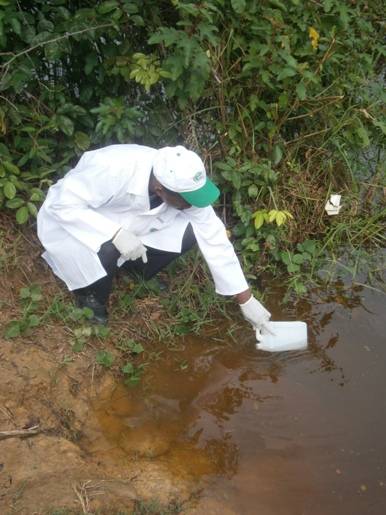

Environmental impact assessment (EIA) is an environmental decision support tool, which provides information on the likely impacts of legislative proposals, policies, development projects, and operational procedures to those who make the decision as to whether the project should be authorized. The purpose of an EIA is to determine the potential environmental, social, and health effects of a proposed development so that those who make the decisions in developing the project and in authorizing the project are informed about the likely consequences of their decisions before they take those decisions and are thereby more accountable. It is intended to facilitate informed and transparent decision-making while seeking to avoid, reduce or mitigate potential adverse impacts through the consideration of alternative options, sites, or processes.
In Nigeria, the need to implement an EIA is a requirement of the Federal Ministry of Environment (FMEnv), State Ministries of Environment (SMEnv), Environmental Protection Agencies, and Department of Petroleum (DPR).
EIA forms part of the spectrum of environmental assessment (EA) processes. Whilst EIA relates to specific projects, EA is a generic term, which also incorporates Strategic Environmental Assessment (SEA) of policies, plans, and programs, and other forms of assessment like Environmental Evaluation Studies (EES), Environmental Audit, Post Impact Assessment (PIA), Preliminary Impact Assessment, Ecological Seabed Surveys (ESS)/Environmental Baseline Study (EBS) and many others. The distinction between these processes is highlighted in the definitions provided below.
Definitions
There are a number of definitions of environmental assessment, EIA, and SEA. Just a sample is given here.
Environmental Impact Assessment (EIA) is a systematic and integrative process for considering possible impacts prior to a decision being taken on whether or not a proposal should be given the approval to proceed (Wood 2003)
Strategic Environmental Assessment (SEA) is a process of prior examination and appraisal of policies, plans, and programs, and other higher-level or pre-project initiatives (Sadler 1996).
Environmental Evaluation Studies (EES) – this is a study carried out to evaluate the impact of an existing facility on the recipient environment
Environmental Audit (EA) – This is a systematic, documented verification process for objectively obtaining and evaluating evidence to determine whether specified environmental activities, events, conditions, management systems conform with audit criteria, and communicating the results of this process to the client.
Post Impact Assessment (PIA) – this is a study carried out to evaluate the impact of a pollution incident or activity on the recipient environment.
Preliminary Impact Assessment Report (PIAR) – This study involves a detailed screening of a project for potential and significant impact and it’s done for a project that doesn’t require a full EIA study.
Ecological Seabed Surveys (ESS) – this is a study carried out at offshore locations to provide the baseline condition in the project area before any such activities are carried out (e.g. offshore drilling or dredging)
Environmental Baseline Study (EBS) – is a study carried out to provide information on the baseline or environmental conditions of a probable project area before project implementation. EBS is to onshore what ESS is to offshore.
It is important to note that the terms defined above have differing interpretations and meanings in different countries, and some terms are often used interchangeably. However, the definitions and distinctions introduced above are used are for the purposes of this unit.
The objective of EIA is not to force decision-makers to adopt the least environmentally damaging alternative, but rather to make explicit the environmental impact of the development so that the environment is taken into account in decision-making. EIA has been regarded as both a science and an art, reflecting the technical aspects, such as impact identification and prediction, as well as the evaluation, management, and presentation of information. EIA is a combination of both art and science. Management aspects in EIA are an art, whereas the technical analysis in the process is based on scientific principles (Roy R, 2001).
Development projects are instrumental to Nepal’s economic growth, yet some of the projects implemented in the past have degraded the very basis of sustained development by over-exploiting natural resources without concern for the maintenance of environmental quality. Economic growth, which proceeds without attention to proper management and replenishment of Nepal’s environmental base, cannot be sustained. It
must be recognized that development and conservation should be in tandem.
It is well known that corrective and remedial actions to solve an environmental problem
can cost much more than preventive or prophylactic measures. Further, corrective measures
implemented to control irreversible damage may not be effective in preventing further
damage. Therefore, it is imperative that development projects be formulated on the basis
of environmental soundness. Environmental impact assessment is a planning tool that can
be applied to any development project to ameliorate potentially negative environmental
impacts by specifying appropriate mitigation measures.
environmental
impact assessment (EIA) is perhaps the most direct and effective means of the combining
the aims of conservation and development
environmental
impact assessment (EIA) is perhaps the most direct and effective means of the combining
the aims of conservation and development
Environmental impact assessment (EIA) is perhaps the most direct and effective means of combining the aims of conservation and development. The process includes identification of key impacts, the prediction of impacts, evaluation and assessment of significance, mitigation measures, post-monitoring, and auditing. EIA process does not in its form seek to impede an investment decision, rather it seeks effective and efficient decision making.
EIA is a management tool for studying and evaluating potential environmental
consequences of proposed development projects in order to (NPC/MOFSC/IUCN, 1995):
• identify beneficial and adverse environmental impacts;
• examine the significance of the environmental implications;
• assess whether adverse impacts can be mitigated;
• recommend preventive and mitigation measures;
• advise whether proposed development projects should proceed;
• inform decision-makers and interested parties about the environmental implications
of projects; and
• provide information for decision-makers to determine whether a project should be
implemented and in what form.
EIA is a management tool for studying and evaluating potential environmental
consequences of proposed development projects in order to (NPC/MOFSC/IUCN, 1995):
• identify beneficial and adverse environmental impacts;
• examine the significance of the environmental implications;
• assess whether adverse impacts can be mitigated;
• recommend preventive and mitigation measures;
• advise whether proposed development projects should proceed;
• inform decision-makers and interested parties about the environmental implications
of projects; and
• provide information for decision-makers to determine whether a project should be
implemented and in what form.
EIA is a management tool for studying and evaluating potential environmental consequences of proposed development projects in order to (NPC/MOFSC/IUCN, 1995):
• identify beneficial and adverse environmental impacts;
• examine the significance of the environmental implications;
• assess whether adverse impacts can be mitigated;
• recommend preventive and mitigation measures;
• advise whether proposed development projects should proceed;
• inform decision makers and interested parties about the environmental implications of projects; and
• provide information for decision-makers to determine whether a project should be implemented and in what form.
`The process includes identification of key impacts, the prediction of impacts, evaluation and
assessment of significance, mitigation measures, post-monitoring, and auditing. EIA
the process is not an obstruction to investment decision, rather it is an aid to decision making.
This provides for a systematic examination of the environmental implication of a proposed
action, and sometimes other alternatives before a decision is taken.
EIA provides a systematic examination of the environmental implications of proposed actions and alternatives to assist decision-making. The cost-benefit and trade off analyses between
the project implementation and associated environmental costs facilitate the decision
makers in making decisions that are more likely to result in sustainable projects.
EIA provides a systematic examination of the environmental implications of proposed actions and alternatives to assist decision-making. The cost-benefit and trade-off analyses between the project implementation and associated environmental costs facilitate the decision makers in making decisions that are more likely to result in sustainable projects.